
POLITICS
2027: Excitement as Senator Akobundu Submits Nomination Form for Senate at ADC National Secretariat


The Senator representing Abia Central Senatorial District, Senator Austin Akobundu, earlier today submitted his nomination form for Abia Central Senatorial District at the National Secretariat of the African Democratic Congress (ADC), in Abuja.
In a brief but significant ceremony marking the beginning of his return to the Senate, Akobundu arrived at the Secretariat about 4:30pm amidst dancing and jubilation by party supporters who thronged the ADC headquarters in their hundreds to welcome him.
After acknowledging party faithful, Senator Akobundu proceeded straight to the office where he submitted his form and underwent all necessary processes before leaving to address the media within the precinct of the party office.
He expressed delight at the quality of aspirants in the African Democratic Congress from across the country and the impressive number of party supporters, describing it as an incontrovertible indication that the ADC is the most widely acceptable party in the country.

He further expressed his trust in the ability of the party’s candidates at the forthcoming 2027 general elections to secure victory for the party across all levels and truly lead Nigeria into the path of peace, progress and prosperity.
“When our candidates are successful at the polls by the special grace of God, they will respond adequately to the current challenges Nigeria faces today.
“So there is hope,” he declared.
Senator Akobundu was accompanied to the party office by national and state party executives and chieftains.
POLITICS
OZIOMA 2027: KELECHI ONYEOBIA’S MOVEMENT SECURES SUPPORT FROM HON. DR. BLESSING UGBOAJA IN OSISIOMA
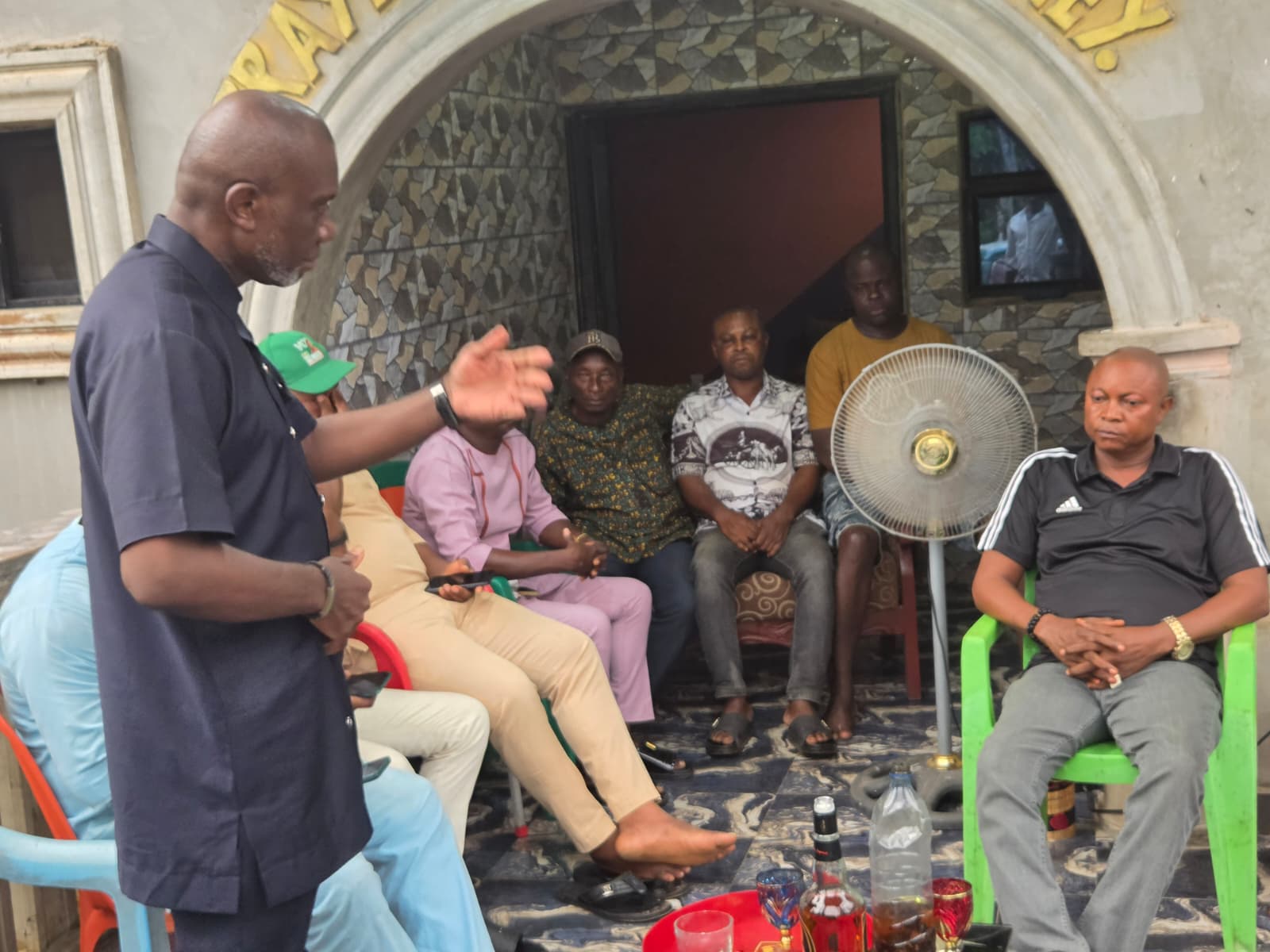
The OZIOMA 2027 Movement, led by Barr. Kelechi Ozioma Onyeobia, has continued its stakeholder engagement and grassroots mobilisation efforts with a courtesy visit to Hon. Dr. Blessing Ugboaja in his hometown of Amator, Osisioma Ward 5.

The visit, which took place on Monday, October 12, 2026, was led by Barr. Kelechi Ozioma Onyeobia and accompanied by Hon. Chief Uche Okezie, Barr. Henry Nna, Director-General of the OZIOMA 2027 Movement, and other members of the delegation.

The engagement formed part of the movement’s ongoing consultations with key stakeholders and community leaders across the Osisioma/Obingwa/Ugwunagbo Federal Constituency, aimed at fostering collaboration, strengthening grassroots relationships, and promoting a shared vision for the constituency’s development.

During the visit, Hon. Dr. Blessing Ugboaja warmly welcomed the delegation and expressed his willingness to support and partner with the OZIOMA 2027 project in the interest of the federal constituency.

His positive reception highlighted the importance of dialogue, mutual understanding, and collective participation in building a political movement that recognises the needs, expectations, and aspirations of the people.

The visit further underscores Barr. Kelechi Ozioma Onyeobia’s commitment to engaging community stakeholders, building meaningful partnerships, and expanding consultations across the constituency as the OZIOMA 2027 Movement advances its vision for the future.
POLITICS
SUPREME COURT JUDGMENT IN INEC v. ZENITH LABOUR PARTY: WHAT IT MEANS FOR CANDIDATES, POLITICAL PARTIES AND PENDING CASES

The recent judgment of the Supreme Court in the Independent National Electoral Commission (INEC) v. Zenith Labour Party (ZLP), Appeal No. SC/CR/495/2026, has generated considerable debate among politicians, lawyers and legal commentators, particularly over the practical implications of the decision for political parties, candidates and ongoing pre-election disputes ahead of the 2027 general elections.
The Supreme Court, in a unanimous decision delivered on September 24, 2026, allowed INEC’s appeal and set aside the earlier judgment of the Court of Appeal which had declared Sections 77(5), 77(6), 77(7) and 84(2) of the Electoral Act 2026 unconstitutional. The apex court restored the legal validity of those provisions and held that they are not inconsistent with the 1999 Constitution.
The decision is significant because Sections 77(5)-(7) regulate political-party membership registers and eligibility to participate in party primaries, while Section 84(2) prescribes direct primaries or consensus as the methods for nominating candidates.
However, the judgment should not be interpreted as a blanket declaration that every candidate whose nomination may be questioned under Section 77 is automatically disqualified.
Section 77(5) provides that only members whose names appear in a political party’s membership register are eligible to vote or be voted for at party primaries, congresses and conventions.
Section 77(6) requires political parties to use the membership register submitted to INEC for those activities, while Section 77(7) provides a consequence where a party fails to submit its membership register within the prescribed period.
The Supreme Court has now restored these provisions as valid law.
Importantly, however, the reported judgment makes clear that the consequence under Section 77 is directed at the political party’s eligibility to field candidates, rather than automatically operating as an individual disqualification against every member of the party.
This distinction is fundamental.
The fact that a statutory provision is constitutionally valid does not, without more, amount to a judicial finding that a particular candidate has been disqualified.
The court must still consider the facts and circumstances of the particular dispute, the nature of the complaint, the standing of the person bringing the action, the applicable limitation period and the specific relief available under the Electoral Act.
Section 84(2) of the Electoral Act 2026 provides that political parties shall nominate candidates through direct primaries or consensus. The Supreme Court has restored this provision after the Court of Appeal had previously declared it unconstitutional.
Consequently, political parties are expected to comply with the statutory framework governing the nomination of candidates.
But once again, the validity of the statutory framework should be distinguished from the legal status of an individual candidate.
Where an aspirant alleges that a party failed to comply with the Electoral Act or its own applicable guidelines in conducting a primary, the law provides a specific judicial mechanism through which that complaint may be determined.
Section 29 requires political parties to submit to INEC the names of candidates who emerged from valid primaries within the prescribed period before the general election.
The provision also establishes a procedure through which certain challenges concerning the constitutional eligibility of a candidate may be brought before the Federal High Court.
Section 33 is equally important because it restricts the ability of a political party to change or substitute a candidate whose name has already been submitted under Section 29, except in circumstances recognised by law, principally death or withdrawal. In the case of death or withdrawal, the Act prescribes a procedure for producing and submitting another candidate.
Section 88 provides another important avenue for an aspirant.
Under Section 88(2), an aspirant who participated in a party primary and complains that the Electoral Act or the party’s guidelines were not complied with in the selection or nomination of a candidate may approach the Federal High Court for redress.
More importantly, Section 88(3) provides that where the Court finds that a political party failed to comply with the Act in conducting its primaries, the party’s candidate for the affected position shall not be included in the election.
The wording is significant: it contemplates a finding by a court.
Therefore, where a complaint ultimately seeks a consequential order affecting an identified candidate’s participation in an election, the statutory framework points towards judicial determination rather than an assumption that the candidate has automatically ceased to be eligible.
The Supreme Court’s earlier decision in Dingyadi & Anor v. Independent National Electoral Commission & 2 Ors (No. 2) (2011) 18 NWLR (Pt. 1224) is also relevant to the broader question of INEC’s powers.
The decision, which arose under the Electoral Act 2006, established an important principle concerning INEC’s inability to unilaterally disqualify a candidate after the candidate’s name has been forwarded to the Commission.
Although the statutory framework of the 2006 Act differs from that of the Electoral Act 2026, the principle remains relevant when considering the relationship between INEC’s administrative responsibilities and the judicial determination of disputes affecting candidature.
The 2026 Act itself provides specific judicial procedures for certain categories of disputes involving qualification, nomination and compliance with the law.
Accordingly, the restoration of Sections 77 and 84 should not be interpreted as conferring upon INEC an unlimited administrative power to remove candidates whose names have already been submitted or published.
One of the most important questions in any pending pre-election dispute will be the date on which the cause of action is accrued.
Section 285(9) of the 1999 Constitution provides that a pre-election matter must be commenced within 14 days from the date of the occurrence of the event, decision or action complained of.
That constitutional limitation is critical.
For example, where an aspirant complains that a particular candidate was not qualified to participate in a party primary because the candidate’s name was allegedly absent from the relevant statutory membership register, the court may have to determine whether the cause of action arose from the primary or nomination process itself.
That is different from a complaint challenging a subsequent act or decision of INEC.
The distinction may determine whether an action was commenced within time or has become statute-barred.
Consequently, the mere fact that INEC subsequently published a candidate’s name does not automatically mean that a fresh cause of action arose in respect of every alleged defect that occurred earlier in the party’s nomination process.
Each case must be examined according to its facts, the particular complaint and the relief being sought.
The Supreme Court’s decision does not necessarily mean that every pending case concerning party primaries or candidate nominations has automatically become incompetent.
What has changed is the legal framework that must guide the determination of such disputes.
Where a pending case is founded on the argument that Sections 77(5)-(7) or 84(2) are unconstitutional, that argument can no longer stand in light of the Supreme Court’s authoritative decision restoring those provisions.
However, a court may still have to determine other questions, including:
Whether the candidate was actually on the relevant membership register;
Whether the political party complied with the applicable statutory requirements;
Whether the claimant was an eligible aspirant with the necessary standing;
Whether the action was commenced within the constitutionally prescribed 14-day period;
Whether the relevant primary was conducted in accordance with the Electoral Act and applicable party guidelines;
What precise relief the claimant is seeking; and
Whether the law permits the court to grant that relief.
Therefore, the ZLP judgment changes the legal framework for determining pending disputes, but it does not automatically convert every pending case into a disqualification proceeding.
This is perhaps the question generating the greatest public interest.
The answer requires considerable caution.
The restoration of Sections 77 and 84 does not, by itself, mean that INEC can simply erase the name of every candidate whose nomination is subsequently questioned.
The Electoral Act establishes different procedures for dealing with different categories of complaints. Section 29 addresses the submission of candidates and certain challenges relating to constitutional eligibility. Section 88 provides a judicial mechanism for complaints concerning non-compliance with the Electoral Act or party guidelines in the selection or nomination of candidates. Section 33 also places restrictions on the substitution of candidates already submitted under Section 29.
The statutory scheme therefore makes the nature of the complaint and the relief sought extremely important.
Where an aspirant has a valid and timely complaint, the relevant question is whether the appropriate judicial procedure has been invoked and whether the competent court, having considered the facts and applicable law, should grant the relief sought.
The Supreme Court’s decision should not be understood as a general administrative licence for INEC to substitute or disqualify already-published candidates outside the procedures established by law.
Three important propositions emerge from the decision.
First, the Supreme Court has restored the validity of Sections 77(5), 77(6), 77(7) and 84(2) of the Electoral Act 2026. The provisions concerning party membership registers and candidate nomination therefore remain part of the applicable electoral framework.
Second, the constitutional validity of those provisions does not automatically amount to an individual judicial determination that every candidate whose nomination is questioned has been disqualified. Indeed, the latest reporting of the Supreme Court judgment indicates that Section 77’s consequence is directed at the party’s eligibility to field candidates rather than automatically disqualifying individual members.
Third, the Electoral Act provides specific procedures for determining disputes concerning candidate eligibility, nomination and compliance. The courts therefore remain central to determining consequential disputes where the law requires a judicial finding.
For any candidate or aspirant affected by the Supreme Court’s decision, the important questions are no longer simply whether Section 77 is valid. That issue has been settled.

The relevant questions include:
When did the cause of action accrue?
Was the claimant an aspirant entitled to invoke the relevant statutory procedure?
Did the claimant have the requisite locus standi?
Was the action commenced within the 14-day constitutional limitation period?
Was the complaint about the conduct of the primary, the qualification of the candidate, the membership register, or an act or decision of INEC?
What specific relief is being sought?
Does the Electoral Act entrust that relief to INEC or to a competent court?
Had the candidate already been submitted and published under the relevant provisions of the Act?
Would the relief sought, in substance, amount to disqualification, exclusion or substitution?
Has the claimant satisfied all procedural and jurisdictional requirements for the action?
These questions cannot be answered simply by stating that “the Supreme Court has restored Section 77.”
The Supreme Court has restored the legal validity of important provisions of the Electoral Act 2026 concerning political-party membership registers and the nomination of candidates.
The significance of the judgment, however, goes beyond the restoration of those provisions. It now requires political parties, aspirants, candidates, INEC and the courts to carefully examine how the restored provisions apply to particular facts.
The judgment does not, without more, amount to a blanket disqualification of candidates who were not parties to the litigation. Nor does the restoration of Sections 77 and 84 automatically confer a general power on INEC to remove or substitute candidates who have already been submitted.
Where a particular nomination is challenged, the court will have to examine the cause of action, the claimant’s standing, the applicable limitation period, the facts surrounding the primary, the relevant statutory provisions and the precise relief sought.
For pending cases, the authoritative interpretation of the Supreme Court must now guide the lower courts. But each case must still be determined on its own facts and within the jurisdiction conferred by the Constitution and the Electoral Act.
The central lesson from the ZLP decision is therefore straightforward:
The Supreme Court has settled the constitutional validity of the disputed provisions. The consequential rights and liabilities of particular candidates must, however, be determined through the appropriate legal procedures and on the facts of each individual case.
Dr. M. O. Ubani, SAN
Legal Practitioner/Policy Analyst
POLITICS
APC Faces Backlash Over Substitution of National Assembly Primary Winners Ahead of 2027 Elections

The All Progressives Congress (APC) has come under heavy criticism following its decision to alter the list of candidates who emerged from its National Assembly primaries, raising fresh concerns about internal democracy and the credibility of the party’s candidate selection process ahead of the 2027 general elections.
While the Peoples Democratic Party (PDP) mocked the APC for substituting the names of some primary winners with others, the Social Democratic Party (SDP) described the move as reckless, and the Labour Party (LP) condemned it as undemocratic. The APC, however, told the opposition to mind its own business and focus on the crises rocking their respective parties, insisting that the changes reflected fairness and the wishes of its members.
Last week, the APC directed its state chapters to release the list of candidates for the 2027 elections and issued Independent National Electoral Commission (INEC) nomination forms for completion and submission. The development triggered mixed reactions, with some aspirants who were declared winners alleging they had been replaced after the May Primary Election Appeal Commission reviewed petitions from the primaries.

Reports indicate that the APC National Working Committee (NWC) overturned the victories of several senatorial candidates and restored six serving senators in nine states based on the recommendations of its appeal committee. The revised list affected senatorial primaries in Kogi, Abia, Benue, Taraba, Ondo, Niger, Kwara, Kaduna, and Ebonyi states.
Among those restored were Senators Sunday Karimi (Kogi West), Emmanuel Udende (Benue North-East), Titus Zam (Benue North-West), Shuaibu Isa Lau (Taraba North), Adeniyi Adegbonmire (Ondo Central), and Olajide Ipinsagba (Ondo North). In Abia South, Prince Paul Ikonne, a former Chief Executive Officer of the National Agricultural Land Development Authority, replaced Edinburgh Erondu.
One notable casualty was former Benue State Governor Gabriel Suswam, whose victory in the Benue North-East primary was nullified in favour of incumbent Senator Emmanuel Udende. The changes have sparked internal disagreements and legal concerns in several states.
Reacting to the development, the PDP described the APC’s action as evidence of a deepening internal crisis, confusion, and lack of transparency. PDP National Publicity Secretary Jungudo Mohammed told newsmen that his party would capitalise on the situation to reclaim power.
“With the change of the candidate list, there is confusion in the APC. Let them continue to remain in confusion. It is our joy to see that they remain in confusion so that we can take advantage of that and take over power,” Mohammed said. He added that the PDP remained open to welcoming politicians who felt unfairly treated by their parties, citing recent joiners like Prof. Iyabo Obasanjo and Prof. Isa Pantami.
The Labour Party condemned the substitutions as an aberration and a mockery of the Electoral Act. LP National Publicity Secretary Ken Asogwa said his party had consistently respected primary outcomes and did not replace winners with non-participants. He recalled similar controversies before the 2023 elections and criticised the lack of repercussions for such actions.
The African Democratic Congress (ADC) warned that the crisis could trigger internal discontent that might cost the APC in 2027. ADC National Publicity Secretary Mallam Bolaji Abdullahi told newsmen that the substitutions had left many APC members bitter and aggrieved. He stressed that the ADC would not replace duly elected primary winners except in cases of voluntary withdrawal, highlighting its use of direct, competitive primaries.
The SDP described the development as undemocratic but maintained it was an internal affair of the APC. SDP National Publicity Secretary Rufus Aiyenigba said his party would not dignify the APC’s “recklessness” with extensive comments, focusing instead on providing alternative solutions to Nigeria’s problems ahead of 2027.

However, the National Coordinator of the Obidient Movement Worldwide, Dr. Yunusa Tanko, defended the APC’s right to handle its internal affairs. He cited Supreme Court positions affirming parties’ authority to nominate candidates through their mechanisms, including appeal processes, and noted similar approaches by other parties like the Nigeria Democratic Congress (NDC).
The NDC also backed the principle of party substitutions. Its National Publicity Secretary, Osa Director, told newsmen that Section 84 of the Electoral Act allows parties flexibility in candidate selection, whether through direct primaries or consensus. He denied allegations of imposition within the NDC and said the party was addressing grievances to prevent members from leaving.
Defending the APC’s decision, the party’s Director of Publicity, Bala Ibrahim, said the changes followed due process through the appeal mechanism and reflected fairness, justice, and the wishes of members. He dismissed the opposition as fractured platforms and urged them to address their own problems.
“It shows fairness and justice. It shows the willingness of our party to go by the wishes of the people,” Ibrahim stated, adding that the APC remained committed to democratic principles and carrying members along.
The revised candidate list and ongoing disputes have created uncertainty over the APC’s nominations as INEC has warned it would reject candidates who did not emerge from properly monitored primaries.


OZIOMA RALLIES ADC OSISIOMA LEADERS FOR 2027, TASKS WARD EXECUTIVES ON GRASSROOTS MOBILISATION

UBANI SAN CHARGES NBA ORON ON ACCOUNTABILITY, SECURITY AND PROFESSIONAL EXCELLENCE AS BAR CENTRE PROJECT TAKES OFF

OZIOMA 2027: ONYEOBIA STRENGTHENS GRASSROOTS SUPPORT IN OBINGWA, ENGAGES NDA MEMBERS

Ahead of Convocation, PhD Graduands Defeat Master’s Counterparts in Friendly Football Match

HRH EZE CHARLES UKATTAH DEFENDS GOVERNOR OTTI, DESCRIBES MEDIA EXCHANGE AS MISUNDERSTANDING

WHEN LEADERSHIP IS WORKING, SYMBOLISM SHOULD NEVER BE ALLOWED TO OVERSHADOW SUBSTANCE. – HON STANLEY NWABUISI
-
 METRO3 months ago
Ahead of Convocation, PhD Graduands Defeat Master’s Counterparts in Friendly Football Match
-
 NEWS8 months ago
HRH EZE CHARLES UKATTAH DEFENDS GOVERNOR OTTI, DESCRIBES MEDIA EXCHANGE AS MISUNDERSTANDING
-
 POLITICS9 months ago
WHEN LEADERSHIP IS WORKING, SYMBOLISM SHOULD NEVER BE ALLOWED TO OVERSHADOW SUBSTANCE. – HON STANLEY NWABUISI
-

 NEWS8 months ago
HRH EZE SIR CHARLES ONORCHIE UKATTAH COMMENDS GOVERNOR ALEX OTTI’S PERFORMANCE, BACKS 2027 RE-ELECTION
-

 ENTERTAINMENT9 months ago
RADIO SHOUT-OUT STEALS HEART: RUBYBILLIONS CELEBRATES MARYFIAT NWANOSIKE’S BIRTHDAY IN STYLE
-

 NEWS5 months ago
Gracelyn Oko Celebrates Mothers, Describes Them as Builders of Destinies and Guardians of Godly Values
-

 NEWS5 months ago
Opotoyom, Ugoeze Emerge Winners of NDC Senate and House of Representatives Primaries in Abia
-

 NEWS8 months ago
ABIA MUST REMAIN NIGERIA’S NEATEST STATE — CATECHIST AMBROSE